

SAT vs ACT — Which Test Is Right for Your Student?
Colleges do not favor one test over the other. Choose the test that helps you earn your highest score.
The SAT and the ACT are the two major standardized tests accepted by virtually every college in the United States. There is no admissions advantage to one over the other — the right test for a student is the one they will score highest on with focused preparation.
The two tests differ in pacing, content emphasis, and structure. Choosing well comes down to understanding those differences and matching them to how your student actually thinks and works under timed conditions.
What Is the Digital SAT?
The Digital SAT is the College Board's fully digital, adaptive version of the SAT. It is organized into two main sections — Reading and Writing, and Math — and takes 2 hours and 14 minutes of testing time. Each section is divided into two modules, and the difficulty of the second module adjusts based on the student's performance in the first module.
Because the Digital SAT is adaptive, it is not simply a shorter online version of the old paper SAT. It rewards precision, consistency, and strong performance early in each section. The Reading and Writing section uses short passages with one question at a time, while the Math section emphasizes algebra, problem solving, data analysis, and advanced math concepts in a more streamlined digital format.
For students, the key question is not whether the SAT is "better" than the ACT. The key question is whether the Digital SAT's adaptive structure, shorter reading passages, and slightly more measured pacing create a stronger scoring opportunity.
What Is the Enhanced ACT?
The ACT, administered by ACT Inc., has also moved toward a more flexible digital testing model. The current Enhanced ACT is shorter and more streamlined than the traditional ACT, with English, Math, and Reading forming the core Composite score. Science is now optional for many test takers, and students who choose Science receive a separate Science score and STEM score in addition to their Composite score.
This change makes the ACT a very different strategic option from the Digital SAT. The ACT is not adaptive; every student works through the same test form. But it remains a faster-paced exam, requiring students to move quickly through English grammar and rhetoric, math, reading comprehension, and — if selected — data-heavy Science reasoning.
The ACT Science section is not a test of memorized biology, chemistry, or physics facts. It is primarily a test of graph reading, data interpretation, experimental design, and logical reasoning under time pressure. For students who process information quickly, perform well on straightforward question formats, and are comfortable making fast decisions, the ACT can still be the stronger scoring path.
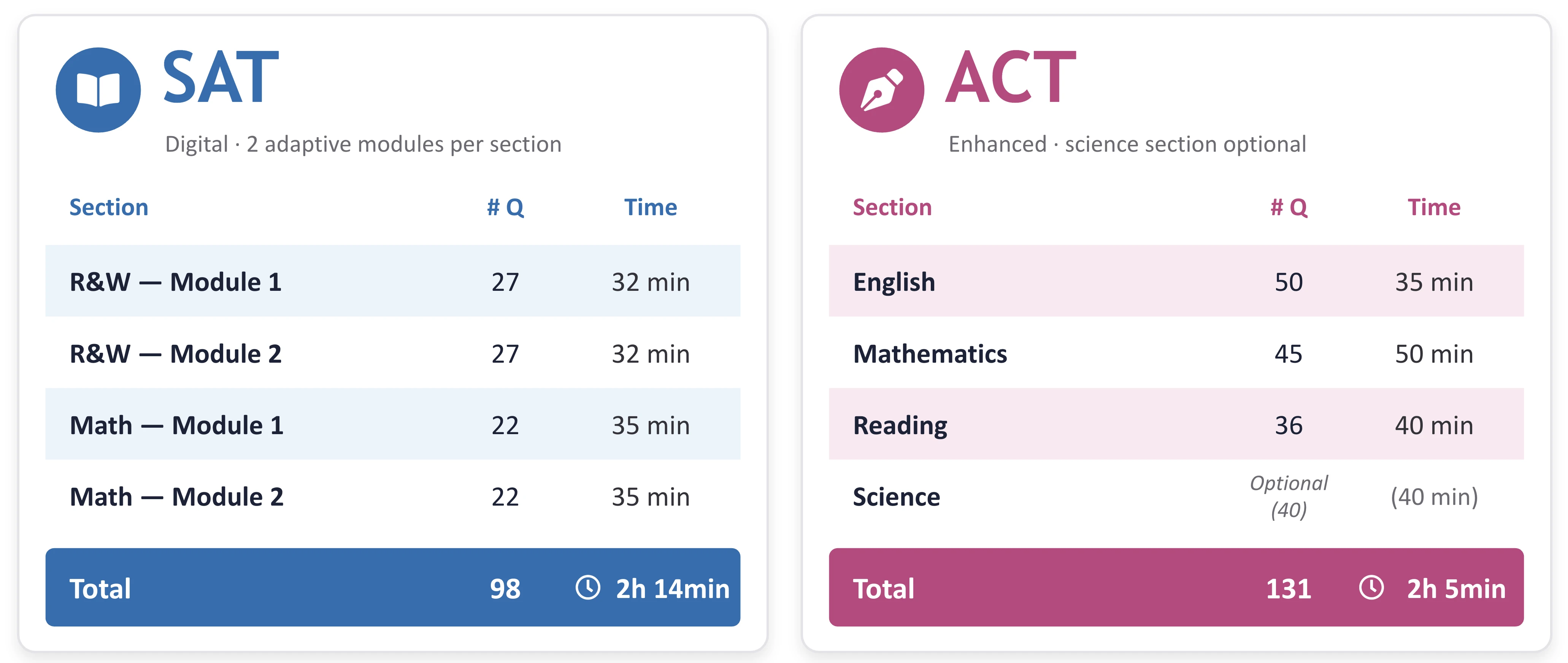
SAT vs ACT at a Glance
| SAT | ACT | |
|---|---|---|
| Format | Digital, adaptive (modules adjust to performance) | Digital, linear (transitioning to fully digital) |
| Length | 2 hr 14 min | 2h 5m, no Science/Essay |
| Sections | Reading & Writing, Math | English, Math, Reading, Science, optional Essay |
| Reading | Short passages — often 1 paragraph per question | 4 longer reading passages |
| Science | None | Dedicated section testing data interpretation & logic, not science knowledge |
| Math topics | Algebra, advanced math, problem-solving, data analysis | Algebra, geometry, trigonometry, probability & statistics |
| Calculator | Allowed on all math (built-in Desmos) | Allowed on all math |
| Essay | None | Optional |
| Scoring | 400–1600 (200–800 per section) | 1–36 composite (average of 4 sections) |
| Per-question pace | ~1.4–1.6 minutes (slower) | ~30–60 seconds (faster) |
How to Decide Which Test to Take
The most reliable method is a head-to-head diagnostic. Take a full-length SAT and a full-length ACT under realistic timed conditions in the same week. Compare results using a concordance table. The test where the student scored higher — and felt better — is the one to commit to.
Some general signals:
- Lean toward SAT if the student reads carefully, prefers analyzing passages deeply, and likes math problems that test reasoning over speed
- Lean toward ACT if the student works fast, handles time pressure well, and is comfortable interpreting charts and data quickly
- Either works if the student is balanced across speed and depth — in which case, take whichever has the closer test date
How A ONE Prepares Students for the SAT and ACT
A ONE offers focused prep tracks for both tests, taught with proprietary materials and ETT TEST mock exams that simulate real digital testing conditions. Each program is built around the specific demands of its test — not generic test-prep theory. Not sure which test is the better fit? Start with a free diagnostic — we'll help you decide before you commit to a full prep cycle.
Frequently Asked Questions
Is the SAT or the ACT easier?
Neither is objectively easier — the better test depends on the student. The Digital SAT moves at a slower per-question pace and emphasizes reading comprehension; the Digital ACT moves faster and includes a dedicated Science section testing data interpretation. Students who read carefully and analyze passages closely often score better on the SAT; students who work quickly across more questions often score better on the ACT.
Do colleges prefer the SAT or ACT?
Virtually all U.S. colleges accept either test equally. There is no admissions preference. The choice should be based on which test a student scores higher on, not which one a target college prefers.
How do I decide whether to take the SAT or ACT?
The most reliable method is to take a timed full-length diagnostic of each test under realistic conditions. Compare the scores using a concordance table, see which test felt better in terms of pacing and content, then commit to that one. Trying to prep for both splits effort and rarely produces top scores in either.
Can I take both the SAT and ACT?
Yes, students are allowed to take both. In practice, focused prep for one test produces dramatically better results than split prep for two. Most students who take both end up submitting only the higher score, making the extra prep time on the other test wasted effort.
Explore A ONE's Test Prep Programs
Ready to choose your test and start prepping? Contact us to schedule a diagnostic.
Related guides: AP vs IB
Last updated: 2026-06-08